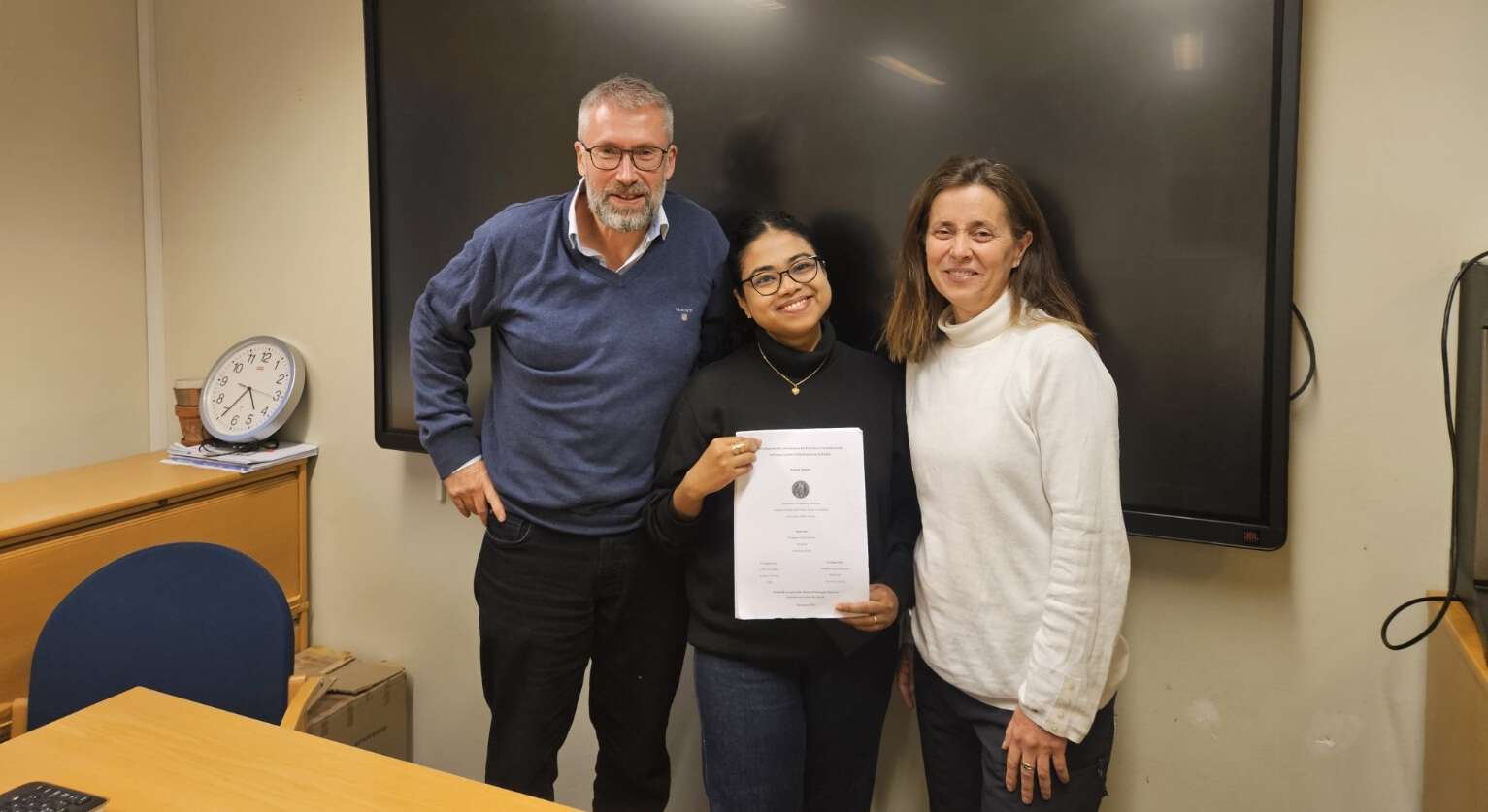
On 27 October 2026, dentist Shraboni Debnath defended her master's thesis in International Community Health at the Faculty of Medicine, University of Oslo. The study was conducted through a research collaboration between Professor Fernanda Cristina Petersen at the Department of Oral Biology and researcher Arunima Sehgal Mukherjee at the Department of Community Medicine and Global Health, Institute of Health and Society, Faculty of Medicine.
As part of her research, Debnath investigated the occurrence and diversity of antibiotic resistance genes in wastewater and soil samples collected from daycare centres in Baddi, India. These environments have received limited attention in previous research, despite their potential role in the spread of antibiotic resistance.
The study identified several antibiotic resistance genes of potential clinical relevance in both wastewater and soil samples. The findings contribute to a growing body of knowledge showing that environmental settings can serve as reservoirs for resistance genes and may play an important role in their spread.
The bacteria that live in and on our bodies, whether in the mouth, the gut, or elsewhere, do not exist in isolation. Humans are constantly exposed to microorganisms in the surrounding environment, and resistance genes can be transferred between bacteria and across ecosystems. Understanding where these genes occur is therefore essential to understanding how antibiotic resistance emerges and spreads in human populations.
This perspective is central to the One Health approach, which recognizes the close connections between human health, animal health, and environmental health. Research on antibiotic resistance in environmental settings can provide valuable insights into the complex pathways through which resistance develops and spreads.
Shraboni Debnath was supervised by Professor Fernanda Cristina Petersen and Achal Dhariwal at the Institute of Oral Biology, Arunima Sehgal Mukherjee at the Faculty of Medicine, and Ulf Reidar Dahle at the Norwegian Institute of Public Health
Kaare Magne Nielsen, Vice Dean for Research and Innovation at the Faculty of Health Sciences, OsloMet, served as the external examiner.