PhD defence
Badra's PhD defence started with her holding a trial lecture on the assigned topic: “Periodontitis and Peri-Implantitis: Distinct Conditions or Two Sides of the Same Coin?” In a well-structured and engaging presentation, Hussain explored the clinical, microbiological, and immunological parallels and distinctions between these two common inflammatory conditions. Her lecture demonstrated both depth of understanding and critical reflection, setting the stage for a strong PhD defence. We congratulate Badra on an excellent performance!
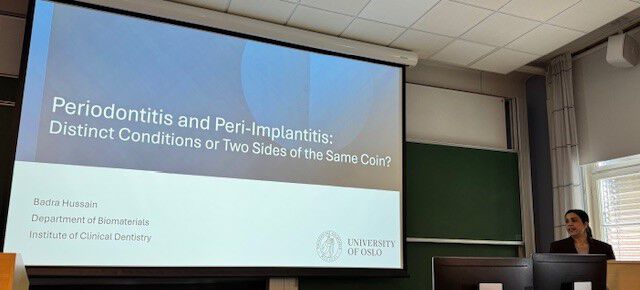
The defence was equally successful as the trial lecture with an in-depth discussion of whether periodontitis and peri-implantitis should be treated the same way and what the best way to approach it.

PhD Thesis
Badra's thesis investigates the treatment of peri-implant disease—an inflammatory condition around dental implants that can lead to bone loss and implant failure. The objective was to determine which therapeutic approaches should be prioritised to improve the management of the condition and to evaluate various chemical decontamination agents. Traditionally, techniques used in periodontology have been applied to dental implants. The project also explored whether newly developed agents for implants could be effective on tooth surfaces. Because the underlying disease processes are similar, this may open up new treatment possibilities for both peri-implantitis and periodontitis.
Badra's thesis contains five published peer-reviewed studies which show that:
-
Patient-related factors (plaque control, sex) outweigh implant surface design in determining peri-implantitis risk; (Surface Topography Has Less Influence on Peri-Implantitis than Patient Factors: A Comparative Clinical Study of Two Dental Implant Systems)
-
Documented the profession’s lack of consensus on decontamination protocols and its concern over antibiotic over-use (Peri-implant health and the knowing-doing gap—a digital survey on procedures and therapies);
-
Demonstrated that a novel hydrogen-peroxide poloxamer gel markedly suppresses biofilm formation without cytotoxicity (Biofouling on titanium implants: a novel formulation of poloxamer and peroxide for in situ removal of pellicle and multi-species oral biofilm); and (A comparative investigation of chemical decontamination methods for in-situ cleaning of dental implant surfaces)
-
Proved that an oscillating chitosan brush improves periodontal pocket reduction more effectively than conventional scaling, with no adverse effects (Treatment of residual pockets using an oscillating chitosan device versus regular curettes alone—A randomized, feasibility parallel‐arm clinical trial).
Collectively, her work underlines the need for patient-centred preventive care and introduces two promising biomaterial-based adjuncts for managing oral biofilm infections.
Examination committee
-
Professor Nagihan Bostanci (Karolinska Institutet, Sweden) – first opponent
-
Associate Professor Leonidas Batas (Aristotle University of Thessaloniki, Greece) – second opponent
-
Professor Amer Sehic (Department of Oral Biology, UiO) – committee member
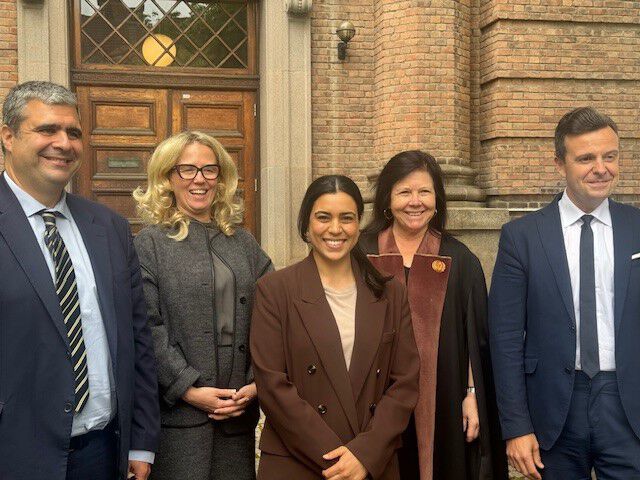
Badra with her evaluation committee
Leadership and supervision
Pro-Dean for Research Janne E. Reseland chaired the session, and Håvard J. Haugen and Caspar Wohlfahrt supervised the thesis.
Looking ahead
Badra’s findings lay the groundwork for larger clinical trials and could inspire new guidelines for both peri-implant and periodontal therapy. We congratulate her on an exemplary doctoral journey and look forward to following her future contributions to the field of biomaterials research.


Photos: Marie Lindeman Johansen and Håvard J Haugen